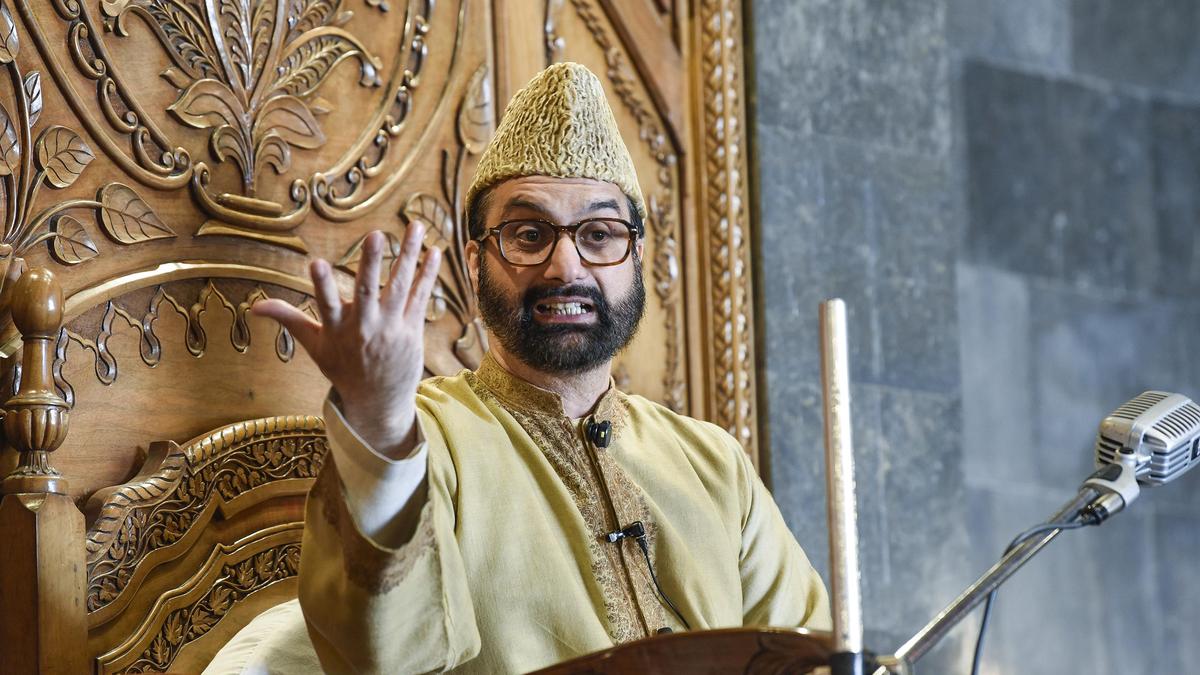
When Mirwaiz Umar Farooq climbed the stairs of the Jamia Masjid pulpit in Srinagar this past Friday, the air carried more than the usual weight of local grievances. For decades, the sermons at this historic site have been the barometer for Kashmiri sentiment. However, the latest address signaled a strategic shift in rhetoric that observers of South Asian geopolitics cannot afford to ignore. The Mirwaiz didn't just speak about the valley; he wove a narrative of a "worrying" global instability, linking the fate of Palestine, Iran, and Afghanistan to the local consciousness.
This is not merely religious solidarity. It is a calculated move to maintain relevance in a landscape where traditional political maneuvering has been squeezed into a corner. By framing the current state of the Middle East and Central Asia as a singular, interconnected crisis, the Mirwaiz is attempting to reposition the Kashmiri cause within a larger, more volatile framework of global Islamic identity.
The Strategic Expansion of Concern
The shift toward global issues isn't an admission of local defeat. It is an expansion of the theater. When the Mirwaiz expresses deep concern over the "unfolding tragedies" in Gaza or the escalating tensions surrounding Iran, he is tapping into a vein of historical memory that resonates with his audience. The Kashmiri public has long seen its own struggles mirrored in the Palestinian resistance. By highlighting these parallels now, the Mirwaiz is ensuring that the local movement does not become an isolated footnote in a rapidly changing world.
The mention of Iran is particularly sharp. In the current climate, where Tehran finds itself in a direct shadow war with Israel and under immense pressure from Western sanctions, the Mirwaiz is signaling an awareness of the shifting tectonic plates in West Asia. He isn't just a cleric; he is an analyst of the Ummah’s vulnerabilities. He sees a world where the old certainties are dissolving, and he wants his followers to see it too.
The Afghanistan Paradox
Perhaps the most complex layer of the sermon was the mention of Afghanistan. Since the Taliban’s return to power in 2021, the regional dynamics have been fraught with contradiction. For the Mirwaiz, Afghanistan represents a "worrying" situation not just because of its internal governance, but because of its potential to destabilize the entire neighborhood.
There is a quiet tension here. While some segments of the conservative base might view the exit of Western powers from Kabul as a victory, the Mirwaiz is looking at the ground reality of a nation struggling with economic collapse and international isolation. He understands that a failed state in Afghanistan exports instability. For Kashmir, a region that has historically felt the ripples of Afghan politics, a chaotic Kabul is a direct threat to any hope of local normalcy.
Breaking the Silence of the Locked Gate
To understand why this sermon matters, one must look at the years of silence that preceded it. The Mirwaiz has spent a significant portion of the last half-decade under varying forms of house arrest or restricted movement. His return to the pulpit is a fragile concession, one that comes with unwritten rules and immense scrutiny.
Every word is measured. When he speaks of Palestine, he is using a globally recognized human rights language that is difficult for local authorities to suppress without appearing to oppose universal principles of justice. It is a sophisticated use of "safe" political space. By focusing on international crises, he maintains his role as a communal leader while navigating the minefield of domestic restrictions that have paralyzed traditional separatist politics.
The Economy of Moral Authority
The Mirwaiz holds a unique position. He is the Mirwaiz-e-Kashmir, a title that carries hereditary religious authority, but he is also a political figure. This duality allows him to act as a bridge. In an era where organized political protest in the valley has been largely dismantled, the Friday sermon remains one of the few places where a collective narrative can be forged.
The pulpit is the last standing megaphone. By discussing the "worrying" situation in Iran and Palestine, he is providing his congregation with a sense of perspective. It tells them that they are not alone in their suffering or their uncertainty. This is the economy of moral authority—distributing a sense of shared destiny to prevent the local population from sinking into a vacuum of political apathy.
The Iranian Factor and Regional Realignment
The inclusion of Iran in the Mirwaiz’s litany of concerns points to a sophisticated understanding of the "Axis of Resistance" and its implications for South Asia. Iran is no longer just a neighboring regional power; it is a focal point for anti-Western sentiment across the Muslim world.
If Iran is drawn into a full-scale conflict, the ripples will be felt in the energy markets of Delhi and the streets of Srinagar. The Mirwaiz is warning of a "polycrisis"—a situation where multiple global disasters overlap to create a catastrophe greater than the sum of its parts. He is signaling that the era of localized conflict is over. Everything is now part of the global churn.
Why Palestine Remains the Primary Lens
Palestine is the "North Star" of this rhetoric. It is the one issue that transcends the internal divisions of the Islamic world. For the Mirwaiz, Gaza is the ultimate proof of what he characterizes as the "failure of the international order." By hammering home the tragedy in Palestine, he is indirectly critiquing the global institutions that he believes have also failed the people of Kashmir.
He doesn't need to name the UN or specific Western powers to make his point. The imagery of Gaza does the work for him. It creates a baseline of skepticism toward international law that he then applies to the broader regional context, including the "worrying" silence he observes regarding other displaced and distressed populations.
The Risk of Internationalization
There is a danger in this strategy. By linking Kashmir so explicitly to the volatile situations in Iran and Afghanistan, the Mirwaiz risks drawing the kind of international attention that local authorities are desperate to avoid. For years, the official narrative has been that the situation in the valley is an internal matter, successfully "managed" and moving toward prosperity.
The Mirwaiz’s sermon disrupts this "managed" peace. It re-inserts the region into the global conversation of "troubled spots." If Kashmiris begin to see themselves as part of a broader struggle involving the Middle East and the Taliban’s Afghanistan, the psychological wall that has been built around the region since 2019 begins to crack.
A Hard Truth for the Status Quo
The "worrying" situation the Mirwaiz describes is, in many ways, a reflection of the loss of control. He is highlighting that despite the heavy security presence and the legislative changes, the hearts and minds of the people are still tuned to a different frequency. They are looking West, toward Jerusalem and Tehran, for cues on how to interpret their own reality.
This isn't about the Mirwaiz seeking a new conflict. It is about him seeking a new vocabulary. The old slogans of the 1990s and 2000s are increasingly seen as obsolete or too dangerous to utter. The language of "Global Islamic Concern" provides a new, more durable shield.
The Impact of the Afghan Vacuum
When discussing Afghanistan, the Mirwaiz is touching a nerve that goes back to the 1980s. The influx of "mujahideen" into the valley following the Soviet-Afghan war changed the trajectory of the Kashmiri movement forever. Today, the concern is different. It is not about an influx of fighters, but an influx of ideology and the vacuum of governance.
The Mirwaiz’s "concern" for Afghanistan is a plea for stability. He knows that an unstable Afghanistan provides a pretext for increased militarization across the entire South Asian corridor. He is advocating for a regional solution, one that recognizes the sovereignty of these nations while demanding a higher standard of human rights—a delicate balancing act for a man in his position.
The Mirror of Modernity
The sermon also addressed the internal pressures within these Muslim societies. In Iran and Afghanistan, the tension between traditional values and the demands of a modern, often protesting population is high. The Mirwaiz is navigating these waters by focusing on the "external" threats to these nations—sanctions, war, and intervention—while keeping the "internal" critiques subtle.
This is the mark of a veteran analyst. He understands that to criticize the internal policies of the Taliban or the Iranian regime too harshly would alienate parts of his conservative base. Instead, he focuses on the "worrying" geopolitical pressure they face, framing them as victims of a broader global imbalance.
The Silence of the Global Community
The underlying theme of the entire sermon was the perceived hypocrisy of the global north. The Mirwaiz is pointing out that while the world watches the destruction of Gaza or the tension in the Persian Gulf, the mechanisms meant to ensure peace are non-functional.
This is a critique of the global status quo.
He is telling his audience that they cannot wait for a "global conscience" to save them. By highlighting the failure of the world to intervene effectively in Palestine or Afghanistan, he is preparing his people for a long, self-reliant endurance. It is a grim message, hidden beneath the standard tropes of a Friday sermon.
The Path Ahead for the Mirwaiz
The return of the Mirwaiz to the public sphere is a test for everyone involved. For the government, it is a test of how much "controlled dissent" they are willing to tolerate. For the Mirwaiz, it is a test of his ability to lead without crossing the red lines that would put him back under house arrest.
By turning his gaze toward Palestine, Iran, and Afghanistan, he has found a way to speak loudly without shouting. He is using the world’s pain to articulate his own. The "worrying" situation he describes is not just a list of foreign policy updates; it is a map of the new world order as seen from a locked-down valley.
The sermon marks the end of the isolationist phase of the Kashmiri leadership. They are no longer just talking to the local administration or the central government in Delhi. They are talking to the world, and they are using the world's most visible tragedies as their dictionary.
Watch the frequency of these global references in the coming weeks. If the Mirwaiz continues to lean into the "International Islamic Crisis" narrative, it suggests a definitive move to bypass the stalled local political process entirely. He is building a bridge to the global Ummah, and that bridge is being paved with the "worrying" realities of a world in flames.