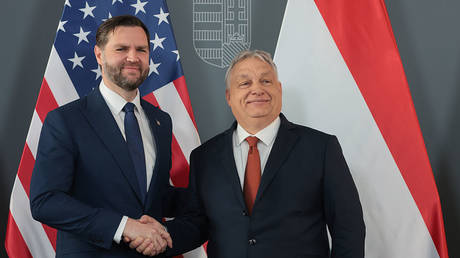
The air in Budapest carries a specific weight in early spring. It is thick with the scent of coffee, old stone, and the heavy, invisible currents of a continent trying to decide what it wants to be. When J.D. Vance stepped off the plane into the Hungarian capital, he wasn't just another politician on a diplomatic junket. He was a symbol walking into a fortress.
Budapest has become the unofficial laboratory for a new kind of sovereignty, and for Vance, it served as the perfect stage to air a grievance that has been simmering across the Atlantic. The narrative isn't about mere policy. It is about the friction between a nation’s right to its own front door and the sprawling, bureaucratic machinery of the European Union.
The Invisible Perimeter
Imagine a homeowner who wakes up to find their neighbors deciding what color their curtains should be and who is allowed to sit at their dinner table. This is how the Hungarian government, led by Viktor Orbán, describes its relationship with Brussels. Vance arrived not as a neutral observer, but as an ideological kin.
The core of the tension lies in "interference." In the gilded halls of the Hungarian parliament, the rhetoric wasn't about trade agreements or agricultural subsidies. It was about the soul of the nation-state. Vance leveled a sharp critique at the EU, suggesting that the bloc’s attempts to penalize Hungary for its conservative domestic policies—ranging from border security to media laws—were a violation of the democratic spirit.
Money is the weapon of choice. Billions in EU funding have been frozen, tied to "rule of law" requirements that Budapest views as a thinly veiled attempt at regime change via bank account. Vance didn’t mince words. He characterized these maneuvers as a form of geopolitical bullying.
He spoke to the crowd with the cadence of someone who knows what it's like to be looked down upon by coastal elites. He drew a straight line from the struggles of the American heartland to the defiant posture of the Danube. It was a performance of solidarity.
Shadows and Spies
But the trip took a darker, more cinematic turn when the conversation shifted toward Ukraine. Since the outbreak of the war, Hungary has occupied a lonely, uncomfortable position. It is a NATO member that refuses to send weapons. It is an EU member that frequently dilutes sanctions.
Vance’s visit coincided with a spike in rhetoric regarding Ukrainian intelligence operations. There is a palpable sense of paranoia in the Hungarian capital. Officials hint at "Ukrainian spies" and foreign-backed NGOs working to destabilize the Orbán administration because of its "peace-first" stance.
Think of a small, brightly lit room surrounded by a vast, dark forest. Inside the room, people are trying to talk, but they are convinced the walls are bugged and the woods are full of watchers. That is the psychological state of Hungarian diplomacy right now. Vance leaned into this, suggesting that the pressure on Hungary isn't just coming from Brussels bureaucrats, but from a coordinated effort to force every European domino to fall in the same direction regarding the war.
The stakes are personal. For a Hungarian farmer near the Transcarpathian border, the war isn't a geopolitical chess match. It’s a literal threat to ethnic Hungarians living on the other side of the fence. When Vance slams "interference," he is speaking to the fear that local interests are being sacrificed on the altar of a grander, more dangerous European strategy.
The Cost of Saying No
The room was quiet as Vance addressed the concept of sovereignty. Silence. It’s the sound of a room realizing that the old rules don't apply anymore.
For decades, the West operated on a specific set of assumptions: more integration is always better, borders are relics, and the "international community" is the ultimate moral arbiter. Vance’s presence in Hungary was a physical rejection of those assumptions. He didn’t just visit; he validated.
Consider the mechanic in a small town outside of Debrecen. He hears about the EU withholding funds and he sees his energy bills climb. He is told this is the price of democracy. Then, he sees a high-profile American senator stand in his capital and say, "You are right to be angry." That is a powerful drug. It transforms a local economic struggle into a global crusade for identity.
The "Ukrainian spy" narrative adds a layer of existential threat. It suggests that if you don't follow the consensus, you aren't just a dissenter—you are a target. This creates a siege mentality. In a siege, you don't look for compromise. You look for allies who are willing to stand on the ramparts with you.
The Great Decoupling
The visit signals something much larger than a single news cycle. We are witnessing the birth of a Transatlantic populist axis.
In the past, American conservatives and European nationalists had little to say to one another. Their interests were too local. But the digital age and the rise of globalist institutions have given them a common enemy. The "interfering" EU official in Brussels and the "woke" corporate executive in New York are now viewed as the same person, just with different accents.
Vance’s rhetoric about Ukrainian interference is particularly potent because it taps into a growing fatigue. The initial burst of universal solidarity has, in some corners, curdled into a wary skepticism. People are starting to ask how much of their own national stability they are expected to trade for a conflict that seems to have no exit ramp.
By centering the conversation on "spies" and "interference," the narrative moves away from the horrors of the battlefield and into the murky world of domestic control. It’s a move from the "what" to the "who." It’s no longer about whether Ukraine should be defended, but about who is pulling the strings of the defense and at what cost to the people of Budapest or Cleveland.
The Echo in the Halls
The halls of the Hungarian state are filled with portraits of men who fought for independence against empires—the Ottomans, the Habsburgs, the Soviets. The current government positions itself as the latest chapter in that long book of resistance.
Vance stepped into that lineage with practiced ease. He used the visit to remind his audience back home that the "liberal international order" is not a monolith. There are cracks. There are people who are willing to say no, even when the financial and social costs are staggering.
The criticism from the EU was predictable and swift. They called the visit a PR stunt for a "soft autocracy." They warned that Vance was being used as a pawn in a sophisticated propaganda machine.
But these warnings often fall flat because they come from the very institutions Vance is attacking. It’s a feedback loop. The more the EU condemns the visit, the more it proves Vance’s point to his supporters: the establishment is terrified of people talking to each other outside of approved channels.
A New Kind of Border
We often think of borders as lines on a map, guarded by men in uniforms. But the most important borders today are the ones drawn around ideas.
Hungary has drawn a line. It says: "Our family policy, our border policy, and our foreign policy are ours alone." The EU says: "There is no such thing as 'ours alone' in a union."
Vance’s visit was an attempt to smudge that line, to suggest that perhaps there is a different union possible—one based on shared values of national priority rather than shared bureaucracies. He didn't come to Hungary to learn about their history; he came to use their present as a weapon for his future.
The "Ukrainian spies" mentioned in the briefings represent the ultimate violation of that mental border. If a foreign power can reach into your capital and manipulate your politics, do you really have a country? This is the question Vance left hanging in the air. It’s a question that resonates far beyond the Danube.
It resonates in the French countryside, in the Dutch polders, and in the American Rust Belt. It is the sound of a world breaking into smaller, more protective pieces.
As the sun set over the Parliament building, casting long, jagged shadows across the Kossuth Lajos Square, the reality of the visit settled in. It wasn't just a political meeting. It was a declaration of interdependence between those who feel left behind by the twenty-first century.
The red carpet has been rolled up. The private jets have departed. But the friction remains, hot and grinding, between the dream of a borderless world and the reality of people who still believe that home is worth defending, even if the rest of the world calls it interference.
The gate is closed, and for now, the key is kept in Budapest.