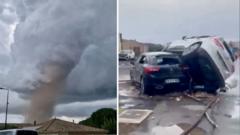
Every single time a violent vortex touches down in the Mediterranean basin, the script writes itself. The media machinery spins into motion, meteorologists reach for the emergency climate jargon, and the public nods along to a comfortable, lazy narrative. A sudden squall rips through the vineyards of the Aude or tears roofs off farmhouses in the Gard, and the headline is pre-packaged: climate change is supercharging French weather, turning rural departments into a disaster movie set.
It is a tidy story. It is also deeply misleading.
I have spent years analyzing severe convective storms across Europe, watching capital and emergency funds get misallocated while local authorities chase phantoms instead of fixing structural rot. The lazy consensus says we are helpless victims of a warming atmosphere. The reality is far more mundane, far more frustrating, and entirely within our control. We are not just fighting nature; we are fighting decades of terrible land management, antiquated zoning laws, and a systemic refusal to look at physical geography.
The Myth of the Unprecedented Fluke
Open any standard report on recent severe weather events in southern France, and you will hear about unprecedented atmospheric instability. They talk about colliding air masses coming off the Pyrenees and the Mediterranean like it is a brand-new meteorological phenomenon invented in the twenty-first century.
History begs to differ.
Southern France has always been a wind funnel. The geography hasn't shifted an inch. The convergence zones between maritime moisture and dry continental air sitting over the Massif Central or the Cévennes create natural triggers for violent updrafts. What has changed is not the sky above; it is the concrete, asphalt, and timber sitting directly in the bullseye.
When a microburst or a localized tornado flattens a modern light-industrial park near Nîmes, commentators shriek about atmospheric anomalies. They fail to mention that the structure was built to minimum cost thresholds using corrugated sheet metal stapled to cinder blocks. When an event strikes older stone farmhouses—structures that have stood for three centuries—the walls stay put while the modern additions peel away like cheap wallpaper.
We are diagnosing an engineering failure as a meteorological emergency.
The Zoning Disaster Nobody Wants to Name
Let us look at the actual mechanics of how land is developed across Languedoc-Roussillon and Provence. Local communes are desperate for tax revenue. They expand urban boundaries outward onto flat, alluvial plains—precisely the open corridors where wind encounters zero natural friction.
Imagine a scenario where a high-velocity downdraft drops out of a supercell thunderstorm. If it hits an ancient landscape laced with dry-stone walls, deep-rooted olive groves, and dense patches of garrigue, the friction breaks the momentum of the near-surface winds. Now, imagine that same downdraft hitting a sprawling commercial zone featuring five hundred acres of uninterrupted parking lot and prefabricated distribution warehouses.
The wind accelerates across the asphalt like a jet on a runway.
Municipalities continue to zone floodplains and wind corridors for low-density commercial boxes because it is cheap and fast. Then, when the inevitable happens, insurance pools foot the bill, the state declares a natural disaster, and nobody asks why we built lightweight cardboard boxes in a documented wind corridor.
The Data We Refuse to Look At
If you dig into the actual climatological records maintained by European severe weather databases, tornado frequency in France has not exploded exponentially. Detection rates have skyrocketed, yes. Every single person with an iPhone is now a storm chaser, capturing every swirling gust of dust in high definition and broadcasting it instantly to millions.
Better observation does not equal a higher baseline frequency.
We are recording more events because we are looking harder and building more infrastructure in harm's way. Every new housing subdivision sliced out of a scrubland hill is a new data point for destruction. We have institutionalized a blind spot where we mistake our own footprint for a wrathful climate.
The financial cost of this denial is staggering. Billions of euros flow into post-disaster relief funds while preventative retrofitting is ignored because it does not make for good television. Politicians love arriving in rubber boots after a storm to promise reconstruction funds. They hate telling local mayors that they need to rewrite building codes, restrict lightweight construction in open valleys, and mandate structural wind-anchoring for existing agricultural hangars.
The Brutal Solution
Fixing this requires an immediate pivot away from fatalism. As long as local officials can shrug their shoulders, point to the sky, and blame global weather patterns, they bear zero accountability for poor planning.
We need to stop treating severe wind events as acts of God and start treating them as stress tests for civil engineering.
- Overhaul Building Codes: Minimum standards for commercial structures in the south of France must be rewritten to withstand straight-line winds and low-end tornadic activity. Sheet metal and foam insulation bolted to steel skeletons are a liability.
- Restore Natural Friction: Replant windbreaks, preserve ancient hedgerows, and stop paving over every square meter of arable valley floor. Nature provided a shock absorber; we ripped it up to build roundabouts and hypermarkets.
- End Perverse Insurance Incentives: When the state automatically covers every weather-related loss without demanding mitigation upgrades upon rebuilding, it subsidizes structural stupidity.
The next time a funnel cloud twists its way across the French countryside, ignore the theatrical panic on your screen. Look at what was built, where it was built, and who profited from cutting corners before the wind ever started to blow.
Don't wait for the next forecast. Fix the foundation.


