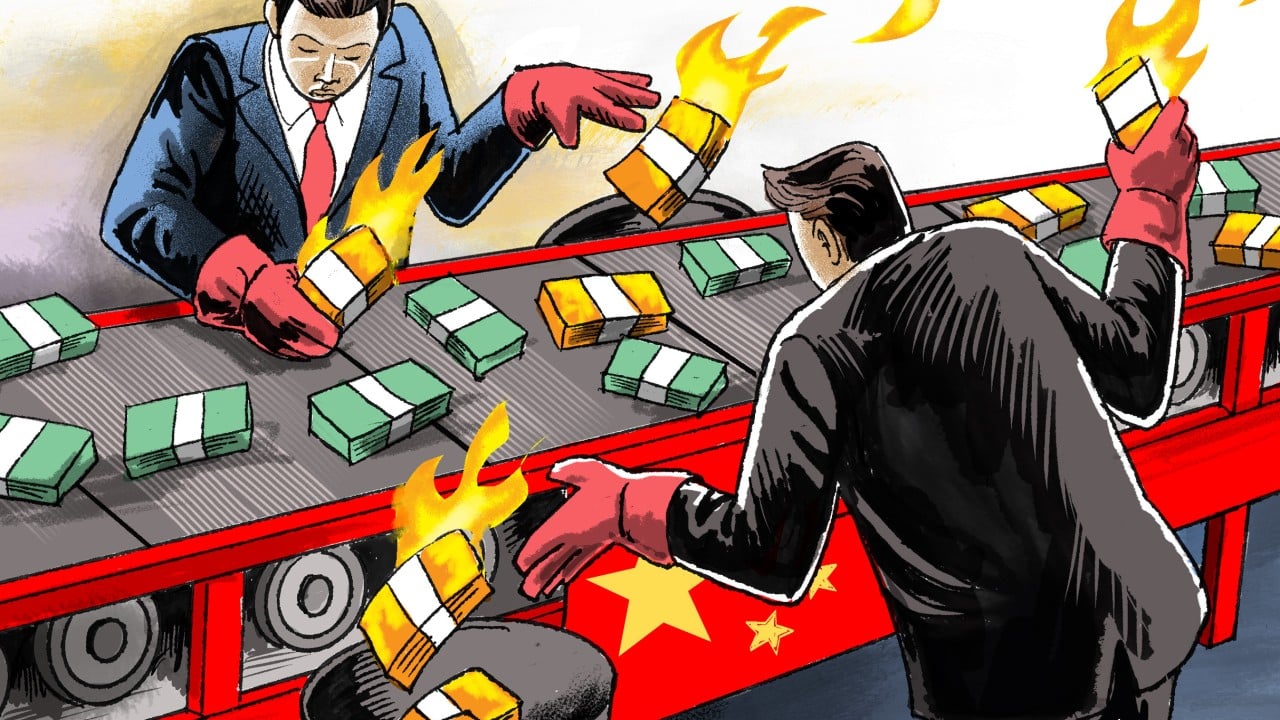
Western analysts have spent two decades writing the exact same headline: "When and how will China ease capital controls?"
The thesis is always identical. They claim Beijing must completely open its capital account if it ever wants the renminbi (RMB) to become a true global reserve currency. They look at the Federal Reserve, they look at Eurozone policies, and they assume China will eventually follow the same playbook.
They are fundamentally wrong.
The lazy consensus ignores a massive structural shift in how global trade and currency power operate. Beijing is not planning a grand liberalizing "reveal." The walls are not coming down. In fact, keeping the gates locked is exactly how China plans to win the global financial game.
The Myth of the Open Account
The mainstream financial press views capital controls as a temporary scaffolding—something Beijing will dismantle once its domestic banking sector matures or its property market stabilizes.
This view misunderstands the fundamental architecture of the Chinese state.
Control over capital flight is not a defensive mechanism; it is an offensive economic strategy. If you open the floodgates completely, you surrender monetary sovereignty to global capital flows and speculative attacks. Look at what happened during the Asian Financial Crisis of 1997 or the taper tantrum of 2013. Emerging markets that fully liberalized their capital accounts were decimated by sudden capital flight.
I have watched multinational institutions dump billions into emerging economies, only to yank that liquidity out at the first sign of a domestic interest rate hike in Washington. Beijing watched those same disasters and drew a permanent conclusion: absolute capital mobility is a structural vulnerability, not an achievement.
Redefining Currency Power Through the Real Economy
The core argument for easing capital controls is that the RMB cannot become a top-tier international currency without full convertibility.
That rule worked in a unipolar, dollar-dominated world. It does not work today.
As prominent economists like Zhu Min and Peng Wensheng have noted, the old assumption that global currency status requires a fully liberalized capital account is collapsing under the weight of geopolitical realities. The United States’ aggressive use of financial sanctions has weaponized the SWIFT system. In response, countries are moving away from financial assets as universal stores of value. They are looking for real-economy linkages instead.
This is where China holds the high cards.
- The World's Factory Floor: China remains the world’s largest goods-trading nation and possesses the most expansive manufacturing ecosystem on earth.
- Commodity Settlement: Beijing is actively shifting bilateral trade agreements with commodity exporters—ranging from Middle Eastern oil producers to South American miners—to settle directly in RMB.
- The mBridge Framework: Infrastructure like the multi-Central Bank Digital Currency Bridge (mBridge) allows direct, cross-border digital settlement between central banks without touching Western intermediary banks.
When a commodity-exporting nation accumulates RMB through trade, it does not need a wide-open Chinese stock market to park its cash. It uses that currency to buy machinery, solar tech, electric vehicles, and industrial components directly from Chinese factories. The currency is backed by industrial capacity, not speculative liquidity.
The Closed Capital Account is a Feature, Not a Bug
Consider a thought experiment. Imagine a scenario where China completely lifts all capital controls tomorrow. Every wealthy individual in Shanghai and Shenzhen can instantly convert their local currency into dollars and buy real estate in Tokyo or equities in New York.
The result would be a catastrophic drain of domestic savings, severe downward pressure on the RMB, and the gutting of the domestic banking system.
Why would policymakers in Beijing ever sign off on that?
Instead, look at what the People's Bank of China (PBOC) actually does. During recent financial reforms, PBOC Governor Pan Gongsheng outlined targeted measures: introducing offshore RMB foreign exchange trading within the Shanghai Free Trade Zone and launching a repo facility specifically for foreign central banks.
Notice the pattern? These are tightly controlled, walled-garden mechanisms. They allow institutional liquidity management for foreign sovereign entities while keeping the domestic retail population locked inside the financial perimeter.
The Actionable Reality for Global Investors
If you are a corporate treasurer or an institutional investor waiting for a "Big Bang" liberalizing moment to move capital freely in and out of mainland China, change your strategy today. It is a pipe dream.
Stop trying to fight the system and learn to navigate the two-tier structure.
- Accept the Closed Loop: Operate under the assumption that capital entering the mainland stays in the mainland. Reinvest domestic profits directly into local supply chains and R&D rather than burning margin trying to engineer complex offshore repatriation schemes.
- Utilize Walled Hubs: Maximize your exposure to Hong Kong and the specialized free trade zones in Shanghai. These are the explicit valves Beijing uses to interact with global markets without compromising its internal monetary defenses.
- Pivoting to Onshore Debt: Take advantage of programs like Bond Connect and Swap Connect. If you need RMB-denominated assets, look to the expanding Panda bond market, where foreign entities issue debt directly inside China's domestic market.
The era of Western financial hegemony dictated that a global currency must look exactly like the US dollar. China is busy proving that a massive industrial base, paired with a tightly controlled capital account, can dictate the terms of 21st-century global trade. The walls are staying up. Deal with it.