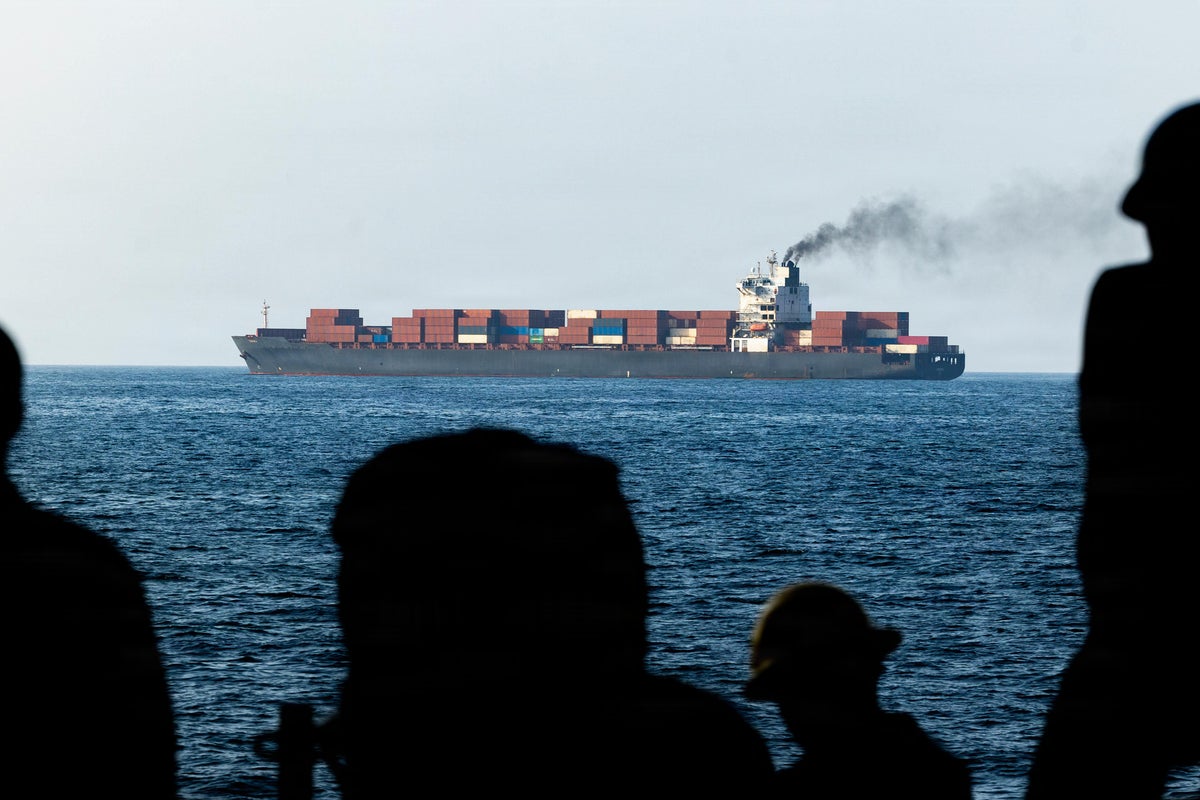
The sea is never as empty as it looks on a map. From a satellite, the Strait of Hormuz is a delicate blue ribbon of water, a narrow throat connecting the Persian Gulf to the open lungs of the Arabian Sea. But on the deck of a 300-meter crude carrier, the reality is far louder and more claustrophobic. You feel the vibration of massive engines beneath your boots. You smell the salt air mixed with the faint, sulfurous scent of unrefined oil. You look at the radar and see dozens of blips—fishing boats, tankers, and gray hulls that belong to no one’s merchant fleet.
Then comes the radio chatter. It isn't always a warning. Sometimes, it is just a demand for identification, delivered in a clipped tone that reminds everyone on the bridge that they are being watched.
For decades, this stretch of water has been the world’s most sensitive jugular vein. Roughly a fifth of the global oil supply pulses through this twenty-mile-wide gap every single day. When that pulse falters, the world feels it in the price of a gallon of gas in Ohio, the cost of a heating bill in Berlin, and the frantic fluctuations of the Tokyo stock exchange.
Recently, the tension in these waters reached a fever pitch. After a period of direct American military strikes aimed at de-escalating regional aggression, a sudden lull in kinetic action did not bring peace. It brought a shift in tactics.
Consider the perspective of a merchant captain. You are navigating a vessel worth hundreds of millions of dollars. Your cargo is volatile. Your crew is tired. You have been told that the "big powers" are stepping back, that the immediate threat of airstrikes has passed. You might expect a reprieve. Instead, you see the fast-attack craft of the Iranian Revolutionary Guard Corps (IRGC) appearing on the horizon like a pack of wolves.
They don't need to fire a missile to win. They just need to step onto your deck.
The Vacuum of Power
Geopolitics loathes a void. When the United States signaled a halt to its retaliatory strikes—a move intended to lower the temperature of a boiling region—the strategic calculus in Tehran did not reset to "neutral." It reset to "opportunity."
The seizure of tankers like the Advantage Sweet or the Niovi isn't about the ships themselves. It is about the message. To the Iranian leadership, the Strait is not international water; it is their front yard. By boarding these vessels, they are conducting a physical audit of global resolve. They are asking a simple, terrifying question: "If we take this ship, who is actually going to stop us?"
This is the invisible stake of the conflict. It isn't just about oil prices. It is about the sanctity of the high seas. If the world accepts that a sovereign nation can snatch a commercial vessel as a bargaining chip for frozen assets or political leverage, the very foundation of global trade begins to crumble.
The logic of the IRGC is cold and consistent. They viewed the American pause in strikes not as an olive branch, but as a blinking light. In their eyes, the absence of a kinetic response is a green light for "gray zone" operations—actions that fall just below the threshold of starting a full-scale war but are disruptive enough to force their enemies to the negotiating table.
The Human Cost of a Standoff
We often talk about these seizures in terms of "tonnage" and "diplomatic friction." We forget the twenty-something-year-old sailors who suddenly find themselves face-to-face with masked men carrying AK-47s.
Imagine a hypothetical third mate named Elias. He’s from the Philippines, sending eighty percent of his paycheck home to put his sister through nursing school. He doesn't care about the JCPOA, the nuances of the Trump-era "maximum pressure" campaign, or the current administration's pivot toward regional stability. He cares about the fact that his bridge has been stormed and he is being forced to steer his ship into Iranian waters at the end of a barrel.
For Elias and thousands of others like him, the Strait of Hormuz is a gauntlet. The psychological toll of sailing through a "seizure zone" is immense. It creates a cascading effect. Insurance premiums for these routes skyrocket. Shipping companies begin to avoid the region, forcing longer, more expensive journeys around the Cape of Good Hope.
This isn't a theoretical exercise in economics. It is a slow-motion strangulation of the global supply chain. When a ship is seized, the cargo—often destined for refineries that provide fuel for hospitals, schools, and transport—becomes a ghost.
A History Written in Salt and Steel
To understand why this is happening now, we have to look back at the "Tanker War" of the 1980s. During the Iran-Iraq conflict, both sides targeted merchant vessels to cripple the other's economy. The U.S. eventually intervened with Operation Earnest Will, the largest naval convoy operation since World War II, to protect Kuwaiti tankers.
The lesson Iran learned then was that they couldn't win a direct naval confrontation with a superpower. But they also learned that the world is incredibly sensitive to even the threat of a closed Strait.
The current strategy is a sophisticated evolution of those 1980s tactics. Instead of sinking ships, they take them. Instead of a frontal assault, they use legalistic excuses—claims of "environmental violations" or "colliding with an Iranian vessel"—to justify what is essentially state-sponsored kidnapping.
It is a masterful, if brutal, game of chess. By seizing ships after the U.S. halted its strikes, Iran is proving that they hold the ultimate "kill switch" for the world economy. They are daring the West to either return to the path of military escalation or to pay the price of admission to use the Strait.
The Illusion of De-escalation
There is a dangerous tendency in modern diplomacy to mistake a lack of noise for a lack of danger. When the bombs stop falling, the headlines tend to fade. But for the maritime industry, the silence is often more terrifying than the noise.
The "quiet" period that followed the halt of American strikes was supposed to be a cooling-off period. Instead, it became a window of vulnerability. It highlighted a fundamental truth about the region: you cannot de-escalate with an opponent who views your restraint as a weakness to be exploited.
This leaves the international community in a grueling position. If they respond with force, they risk a regional conflagration that could spike oil prices to $200 a barrel. If they do nothing, they hand over the keys to the world's most important waterway to a regime that uses piracy as a policy tool.
The ships currently sitting in Iranian ports—the Advantage Sweet, the Niovi, and others—are more than just steel hulls. They are monuments to a broken system of international law. Their crews are pawns in a game they never asked to play.
The Ripples in the Water
Every time a ship is diverted, a vibration runs through the entire world. It’s a subtle shift. Maybe the cost of shipping a container of electronics goes up by three percent. Maybe a refinery in India has to source its crude from South America at a higher premium.
But the real cost is the loss of certainty.
The global economy is built on the assumption that if you put a product on a ship and send it across the ocean, it will arrive. That assumption is the bedrock of our modern life. It’s why you can buy a smartphone for a week's wages and why the shelves at your grocery store are never empty.
When the IRGC boards a ship, they aren't just seizing oil. They are seizing that certainty. They are reminding us that our entire way of life depends on a few miles of water that they control.
There is no easy exit from this cycle. Diplomacy requires a willing partner, and military force requires a stomach for the consequences. For now, the sailors in the Gulf will continue to watch their radars with a knot in their stomachs. They will listen to the radio and wonder if the next voice they hear will be a friendly greeting or a command to surrender.
The sun sets over the Persian Gulf, turning the water into a sheet of liquid gold. It looks peaceful. It looks like the kind of place where nothing could go wrong. But beneath the surface, the currents are shifting. The wolves are still out there, waiting for the next gap in the fence, the next moment of hesitation, the next ship to wander too close to the shadow of the coast.
The Chessboard is set. The pieces are moving. And the world, whether it realizes it or not, is holding its breath.