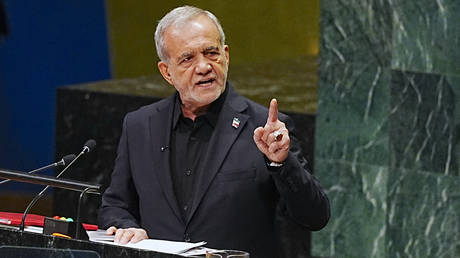
When state actors operate under conflicting systemic imperatives, public moral appeals function primarily as signaling mechanisms rather than actionable policy shifts. Volodymyr Zelenskyy’s address at the United Nations directed toward New Delhi highlights a fundamental friction point in contemporary international relations: the collision between universalist normative frameworks and realist strategic calculus. For decades, Indian foreign policy has operated on the premise of strategic autonomy—a doctrine designed to maximize national interest across competing poles of global power. When external actors attempt to frame this non-alignment as moral passivity or complicity, they misread the underlying systemic constraints that dictate South Block's decision-making architecture.
The Trilemma of Non-Alignment
To understand why direct diplomatic pressure from Kyiv fails to alter New Delhi’s trajectory, one must deconstruct the tripartite constraints governing Indian foreign policy. Statecraft in a multipolar system is bounded by three competing imperatives:
- Territorial security and containment of immediate regional adversaries.
- Macroeconomic stability through uninterrupted access to essential commodities.
- Industrial modernization and technological diversification.
Pursuing any two of these objectives often incurs direct friction with the third. In the current geopolitical configuration, maintaining border security against northern threats requires sustaining high-tempo military readiness, which historically depends on defense supply chains established during the Soviet era. Simultaneously, insulating domestic inflation from global commodity shocks necessitates opportunistic energy procurement. When international bodies demand absolute alignment on European security matters, they require the dismantling of these baseline security and economic cushions. The calculus in New Delhi is straightforward: abstract normative alignment cannot supersede concrete national security imperatives.
The Economic Mechanics of Energy Procurement
The baseline driver of India's commercial engagement with Moscow is rooted in price elasticity and balance of payments management. In periods of global supply constriction, importing discounted crude oil provides a critical fiscal buffer. The mechanism operates through straightforward market arbitrage: procuring discounted petroleum products reduces domestic refining input costs, moderates retail fuel inflation, and preserves foreign exchange reserves that would otherwise be depleted by spot-market purchases from alternative suppliers.
Critics often evaluate these transactions through a purely moral lens, ignoring the structural cost function borne by developing economies when energy supply lines experience artificial compression. If a state importer were to sever ties with a primary discounted energy source without an immediately available, cost-equivalent substitute, the resulting inflationary shock would directly contract industrial output and depress consumer purchasing power. Strategic choices are bound by fiscal gravity. The procurement strategy is not an endorsement of foreign military operations; it is an exercise in macroeconomic risk mitigation.
The Defense Architecture Dependency Vector
Military procurement creates long-term technological path dependency. For decades, India’s defense apparatus integrated Soviet and post-Soviet hardware systems across armor, aviation, and naval platforms. Transitioning a national defense inventory away from a primary supplier is not a binary switch that can be flipped via diplomatic exhortation; it is a multi-decade logistical operation.
The maintenance, repair, and overhaul (MRO) ecosystem for existing platforms relies on continuous component flows and technical cooperation. While policies aimed at domestic defense manufacturing seek to decouple domestic capability from foreign reliance, indigenous production timelines operate on multi-year development cycles. Attempting to accelerate this transition artificially by cutting off established supply lines prior to domestic production maturity would introduce critical operational vulnerabilities into active military formations. National defense planners cannot trade verified operational readiness for symbolic diplomatic gestures.
Multilateral Signaling Versus Bilateral Pragmatism
High-level diplomatic statements delivered from international podiums serve specific rhetorical functions within global public relations campaigns. Their primary utility is to maintain international pressure, shape media narratives, and raise the political cost of neutrality for undecided states. However, bilateral statecraft operates on a different frequency. Channels of communication between New Delhi and Moscow, as well as between New Delhi and Western capitals, function through quiet, transactional diplomacy rather than public admonition.
When leaders of embattled nations direct public warnings toward non-aligned capitals, they misjudge the audience. South Block views international conflicts through the prism of its own core priorities, chief among them being continental security challenges along its Himalayan frontier and maritime security in the Indo-Pacific. From this vantage point, European security concerns, while significant, occupy a different tier of strategic urgency. Expecting a nation preoccupied with regional containment and domestic economic upliftment to reorder its foreign policy priorities based on transatlantic security imperatives reflects a fundamental misunderstanding of decentralized multipolarity.
The divergence between moral appeals and realist execution will persist as long as systemic vulnerabilities remain unaddressed by the global community. As India diversifies its military procurement portfolio toward domestic manufacturers and alternative international suppliers, the relative weight of legacy supply chains will gradually diminish. Yet, this transition is governed by technical realities, not political proclamations. Future diplomatic friction will continue to test the boundaries of non-alignment, requiring foreign ministries to navigate competing pressures without compromising core developmental and security objectives. Strategic autonomy functions as a calculated response to a fragmented world order, dictated by material necessity rather than rhetorical persuasion.