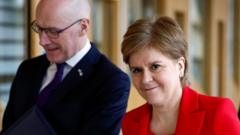
Every political commentator in Edinburgh and London is currently hyperventilating over a phantom soap opera. The lazy consensus gripping the commentariat is that Nicola Sturgeon and John Swinney are locked in a silent civil war, a factional bloodbath tearing the Scottish National Party apart from the inside out. Headlines scream about diverging legacies, hidden criticisms, and an inevitable ideological fracture.
It is a narrative built by people who mistake tactical discipline for terminal division.
I have watched political movements tear themselves apart over real ideological vacuums, and what is happening in the SNP right now does not resemble a fracture. It resembles a stress-test. The lazy narrative assumes that because two leaders possess starkly different temperaments, administrative styles, and public personas, they must be at war. That is a child's understanding of institutional power. Sturgeon governed through sheer gravitational pull and high-stakes polarization; Swinney is a pragmatic technocrat cleaning the engine room.
Pretending this is a betrayal misses the entire mechanics of how dominant nationalist parties manage generational transitions.
The Myth Of The Monolithic Movement
Let us dismantle the core fallacy driving these daily bulletins: the idea that political parties should operate like synchronized swimming teams.
When a dominant figure like Sturgeon steps down, the automatic assumption from outside observers is that their successor must either carbon-copy their approach or publicly repudiate it. When Swinney steps into the Bute House office and recalibrates tone, prioritizes competence over confrontation, and dials down the rhetorical heat, political journalists read it as an indictment of the past.
That is not an indictment. That is a gear shift.
Sturgeon’s tenure was defined by permanent mobilization. You cannot keep a population at a permanent pitch of revolutionary urgency for a decade without burning out the machinery of governance. Swinney knows this. Sturgeon likely knows this better than anyone, having lived inside the furnace of that pressure cooker for years. If she offers critique or distance, it is not because she is sabotaging her successor; it is because she occupies the freedom of the ex-leader's bench, where the constraints of institutional diplomacy no longer bind her tongue quite as tightly.
To call this tension is to misunderstand how political dynasties maintain survival. True internal chaos looks like the implosion of the UK Conservative Party between 2016 and 2024. What is happening in Holyrood is a calculated division of labor: one figure holds the ideological baseline, while the other manages the messy, unglamorous mechanics of state administration.
The Technocrat Versus The Icon
To understand why the Sturgeon-Swinney dynamic baffles outsiders, you have to look at how political authority is accumulated.
Sturgeon operated as a movement leader. Her currency was emotional resonance, international visibility, and sharp constitutional pressure. She framed politics as a moral crusade. Swinney, by contrast, is an institutionalist through and through. He is an Excel-spreadsheet creature who treats government as a complex administrative puzzle rather than an ongoing campaign rally.
When you swap a charismatic crusader for a backroom numbers man, the atmosphere shifts overnight. The media interprets this shift as a loss of momentum.
Imagine a scenario where a corporate CEO steps down after a decade of hyper-growth driven by bold marketing and high-risk expansion. The board replaces them with an austere Chief Operating Officer tasked with fixing the supply chain, balancing the balance sheet, and restoring operational stability. The stock price might dip temporarily. Analysts panic and declare the company is losing its soul. But anyone who understands business cycles knows the COO is doing the gritty work required to survive the next decade.
Swinney is the COO. Sturgeon was the visionary founder. Conflating different operational styles with ideological warfare is amateur hour.
The Accountability Trap
The media loves to frame political critique as disloyalty because conflict sells newspapers and generates clicks. But political parties that cannot stomach internal friction are cults, not coalitions.
The SNP has spent nearly two decades as a broad church holding together social democrats, rural conservatives, business owners, and radical republicans solely through the magnetic force of the independence question. Once the immediate mechanism for a quick referendum stalled, that coalition was bound to strain.
The mistake is assuming Swinney and Sturgeon are fighting over the wreckage. They are managing the decompression.
If Sturgeon critiques the pace or direction of current strategy, she is signaling to her base that the core ambitions remain untouched, preventing the populist wing from wandering off into political irrelevance. Meanwhile, Swinney plays the adult in the room, reassuring moderate voters that the trains still run on time. It is a classic good-cop, bad-cop routine played across historical epochs rather than interrogation rooms.
The Real Threat Is Boredom, Not Betrayal
The obsession with interpersonal drama inside the SNP blinds everyone to the actual crisis facing the party: strategic exhaustion.
The electorate is tired. Not just of the SNP, but of the entire constitutional loop that has dominated Scottish political discourse for fifteen years. Voters do not care about whispered grievances between former and current leaders when their local services are creaking and the cost-of-living squeeze persists.
By hyper-focusing on manufactured soap operas about Sturgeon and Swinney, the political press provides the SNP leadership with a convenient smokescreen. It keeps the spotlight on internal palace intrigue rather than the harder question of how a tired administration plans to reinvent its economic pitch.
The commentators want you to believe that a sharp word or a subtle policy divergence between two veterans spells doom. It does not. It spells business as usual in a party trying to figure out how to govern past its own peak.
Stop looking for the dagger in the dark. There is no civil war. There is only the brutal, boring reality of politicians trying to keep a coalition alive long after the initial magic has worn off.